

Last Updated: November 13, 2026
Pick up three different packets of the same product and you may see three different labels. One lists E300, another says ascorbic acid and a third just says vitamin C. Nobody is mistaken. Each label borrows its name from a different system: food regulation, chemistry and everyday speech.
Laboratory peptides collect names in exactly the same way. A short chain of amino acids can have a nickname, a code from the lab that first made it, a registry number and a database record, and papers from different decades use different ones. Anyone trying to find out what has been published about a compound has to gather its names first.
Table of Contents
Four kinds of name
The everyday name. This is the short label used in conversation and on supplier websites. It is convenient but loose. Two sellers can use one short name for molecules that differ slightly.
Code names. Research groups often give a compound a code of letters and numbers while they work on it. Early papers may use nothing else.
The CAS Registry Number. The Chemical Abstracts Service numbers every distinct substance with three blocks of digits. Two products with the same CAS number are, on paper, the same substance, which is why it is the number buyers and journals lean on most.
Database identifiers. PubChem, the free chemistry database run by the US National Library of Medicine, gives each compound its own numeric ID and collects the structure, formula and known synonyms on a single page. It also lists an InChIKey, a 27-character code worked out from the structure itself, so unlike a name it cannot drift.
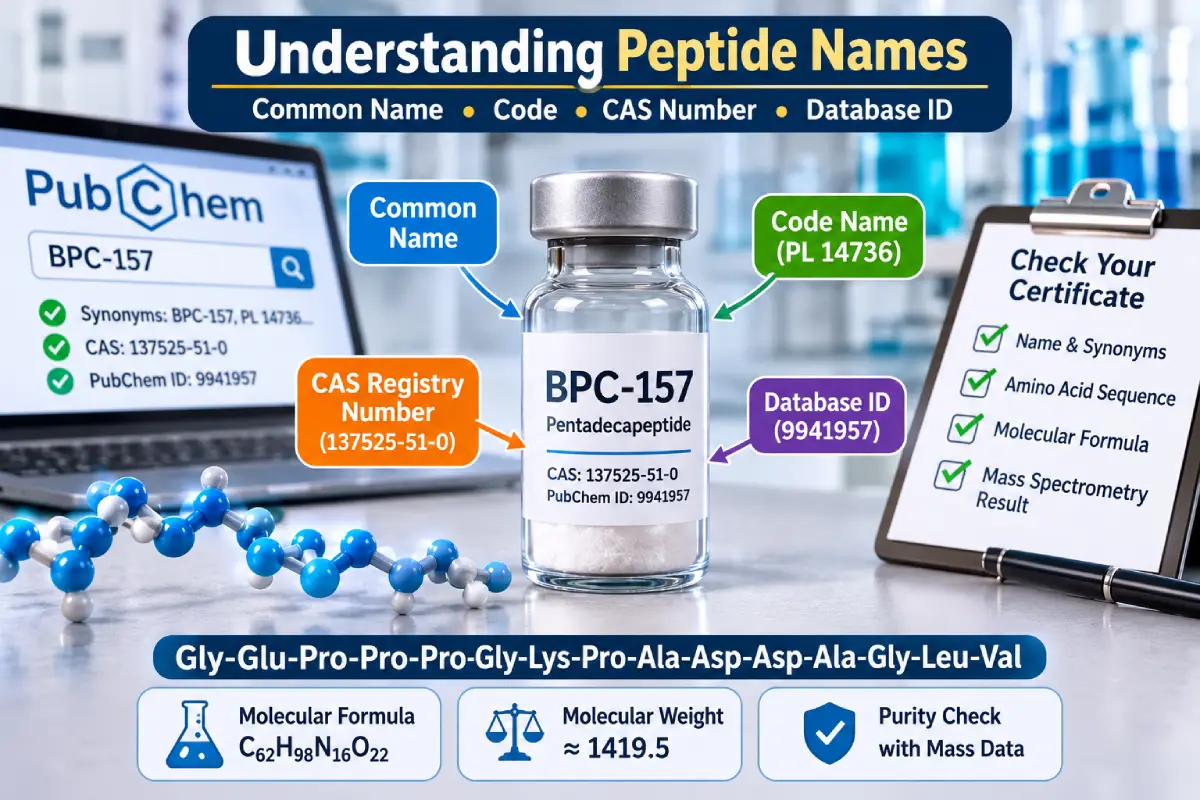
One example in full: BPC-157
BPC-157 is a good case because it has all four. It is a chain of 15 amino acids, a pentadecapeptide. Its name abbreviates “body protection compound”, the name given to a larger protein from which the sequence was originally taken in the early 1990s.
Using three-letter amino acid codes, the sequence reads:
Gly-Glu-Pro-Pro-Pro-Gly-Lys-Pro-Ala-Asp-Asp-Ala-Gly-Leu-Val
From that you get the molecular formula C62H98N16O22 and a molecular weight of roughly 1419.5. The CAS number is 137525-51-0 and the PubChem ID is 9941957. Older papers also use PL 14736, PLD-116 and bepecin. When a laboratory buys research-grade BPC-157, those details are what should agree across the product page, the vial label and the batch’s certificate of analysis.
The practical lesson is about searching. A PubMed search for “BPC-157” alone will miss any paper that only uses a code. Joining every synonym with OR finds far more. It works the other way round too: searching a supplier catalogue by CAS number turns up listings that spell the common name differently.
Checking a certificate against the database
A certificate of analysis is the testing laboratory’s report on one production batch. It should describe the compound in terms you can verify, and a quick comparison with the database page takes a couple of minutes:
| The certificate says | Check it against |
| Name and synonyms | The synonym list on the PubChem page |
| Amino acid sequence | The database sequence, one residue at a time |
| Molecular formula | The formula on the PubChem page |
| Mass found by mass spectrometry | The calculated molecular weight, within about one unit |
The last row carries the most weight. Mass spectrometry weighs the molecules in a sample, so a measured mass close to the calculated one is direct evidence that the sample holds the molecule named on the label. A certificate with a purity percentage and no mass tells you how clean the powder is, but not what it is.
Three habits that save time
- Begin at the database page. PubChem shows the full set of synonyms and links to papers that use any of them, so you know every name before you search.
- Read the sequence in the methods section. Papers sometimes study modified versions, with a changed end or a swapped amino acid, under a near-identical name. The methods say which molecule was actually used.
- Look at the year. A code used in one decade may be replaced by a common name in the next, so an older paper can seem unrelated until you compare identifiers.
None of this needs a laboratory. It needs a free database, some patience and the habit of treating a name as a starting point. The same habit works just as well on a supermarket shelf.
Zachery Casey runs Amidae, a UK supplier of peptides for laboratory research use only. Each batch is sent to an independent laboratory for testing.