

Table of Contents
Definition
Probiotics are made from live bacteria and yeasts that live naturally in your body. You have good and harmful bacteria in your body. When you have an infection, there are more unbalanced bad bacteria. Good bacteria help eliminate other harmful bacteria by returning balance.
What are probiotics?
Probiotics are defined as “live microorganisms which, when administered in adequate amounts, confer a health benefit on the host.” They help maintain a balanced gut microbiome, may improve digestion, support immune function, and can be used to help with certain gastrointestinal conditions such as antibiotic‑associated diarrhea and some forms of infectious diarrhea.
Most commercial probiotics are bacterial, but some products also contain beneficial yeasts such as Saccharomyces boulardii.
What types of bacteria are in probiotics?
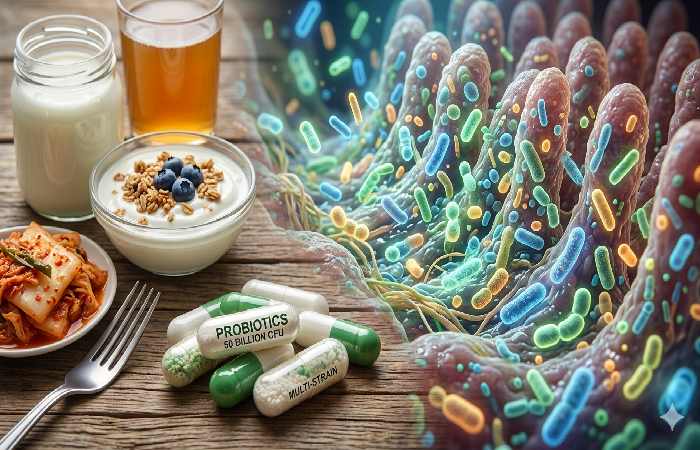
The most widely used probiotic microorganisms come from a few main groups:
- Lactic acid bacteria genera
- Lactobacillus (for example, L. acidophilus, L. rhamnosus, L. casei).
- Bifidobacterium (for example, B. bifidum, B. longum, B. lactis).
- Other bacterial genera
- Streptococcus (e.g., S. thermophilus in fermented dairy).
- Bacillus (spore‑forming strains used in some soil‑based or “probiotic blend” products).
- Enterococcus and certain Escherichia strains also appear in some probiotic formulations, though less commonly.
- Yeast probiotics
- Saccharomyces boulardii, a beneficial yeast used for diarrhea and some gut‑health conditions.
Health effects are often strain‑specific, meaning different strains of the same species can have different benefits.
How popular are probiotics?
Probiotics have become very popular over the last two decades as research on the gut microbiome has expanded. The global probiotic market is estimated to be worth around 15 billion USD per year, with annual growth rates of roughly 7% or more, driven by functional foods, supplements, and infant formulas.
They are widely available in supermarkets, pharmacies, and online, and are commonly used for digestive comfort, immune support, and general “gut health” maintenance, even though evidence strength varies by condition.
How are probiotics regulated in the United States?
In the United States, probiotics are regulated mainly as dietary supplements or foods, but they can also fall under drug regulations depending on the claims made for them.
- As dietary supplements:
- Most probiotic capsules and powders are sold as supplements under the Dietary Supplement Health and Education Act of 1994.
- Manufacturers must ensure safety and can make “structure/function” claims (e.g., “supports digestive health”) but cannot claim to treat, cure, or prevent diseases without FDA approval.
- As foods or food ingredients:
- Probiotics in yogurt, fermented milks, or other foods are generally regulated as food ingredients and must comply with FDA food‑safety rules.
- As drugs or biologics:
- If a product is intended to treat or prevent a specific disease (for example, certain Saccharomyces boulardii preparations for Clostridioides difficile infection), it may be approved or marketed as a drug or biologic, which requires more rigorous clinical‑trial data and FDA review.
Overall, the U.S. regulatory framework is complex and claim‑driven, which means the same microorganism can be treated differently depending on how the product is labeled and marketed.
Comparison between probiotic foods and probiotic supplements
| Category | Probiotic Foods | Probiotic Supplements |
| Examples | Yogurt, kefir, sauerkraut, kimchi, miso, kombucha, natto, pickles, some cheeses, buttermilk, tempeh, sour cream, cottage cheese. | Capsules, tablets, powders, and gummies (e.g., Culturelle, Ritual Synbiotic+, Garden of Life, Seed DS‑01, etc.). |
| Main form | Whole foods or fermented foods consumed as part of meals and snacks. | Concentrated products taken daily, often on an empty stomach or with meals. |
| Strains & CFUs | Usually contain a few strains at lower, variable colony‑forming units (CFUs); contents depend on brand and fermentation. | Often clearly labeled with specific strains (e.g., Lactobacillus and Bifidobacterium spp.) and high CFUs (millions–billions per dose). |
| Benefits focus | Provide probiotics plus nutrients (protein, vitamins, minerals, fiber) and are part of a broader healthy diet. | Target specific gut‑health goals (e.g., bloating, antibiotic‑related diarrhea, immune support) with higher, more controlled doses. |
| Regulation & control | Regulated as regular foods; probiotic content is not always standardized or guaranteed. | Regulated mainly as dietary supplements in the U.S.; labels show strain(s) and CFUs, but efficacy depends on proper storage and use. |
| Practicality | Easy to include in daily meals; good for general maintenance of gut health. | Better when precise dosing, higher strength, or specific strains are desired, or when fermented foods are hard to tolerate. |
Conclusion
One of the things you have to understand about supplements is that there are too many types of them. For example, a commonly used type of bacteria is acid milk. But there are more than 120 species of acidic dairy, at least a dozen of which are using as probiotics.
What’s more, there are multiple other types of bacteria, each with dozens of species, which leads to so many available types of probiotics that it provokes vertigo. Even when you select a kind of bacteria, the amount within the supplement can vary from brand to brand.
When taking probiotics, look for the condition you want to treat and produce probiotics based on that condition. Also, remember that while probiotics may seem promising in treating an illness, scientific research is likely to be in the early stages.
While the supplement may improve the situation of a few people in minimal circumstances, it may not work as efficiently in actual cases. As always, when considering taking a supplement, you should talk to your doctor first.