

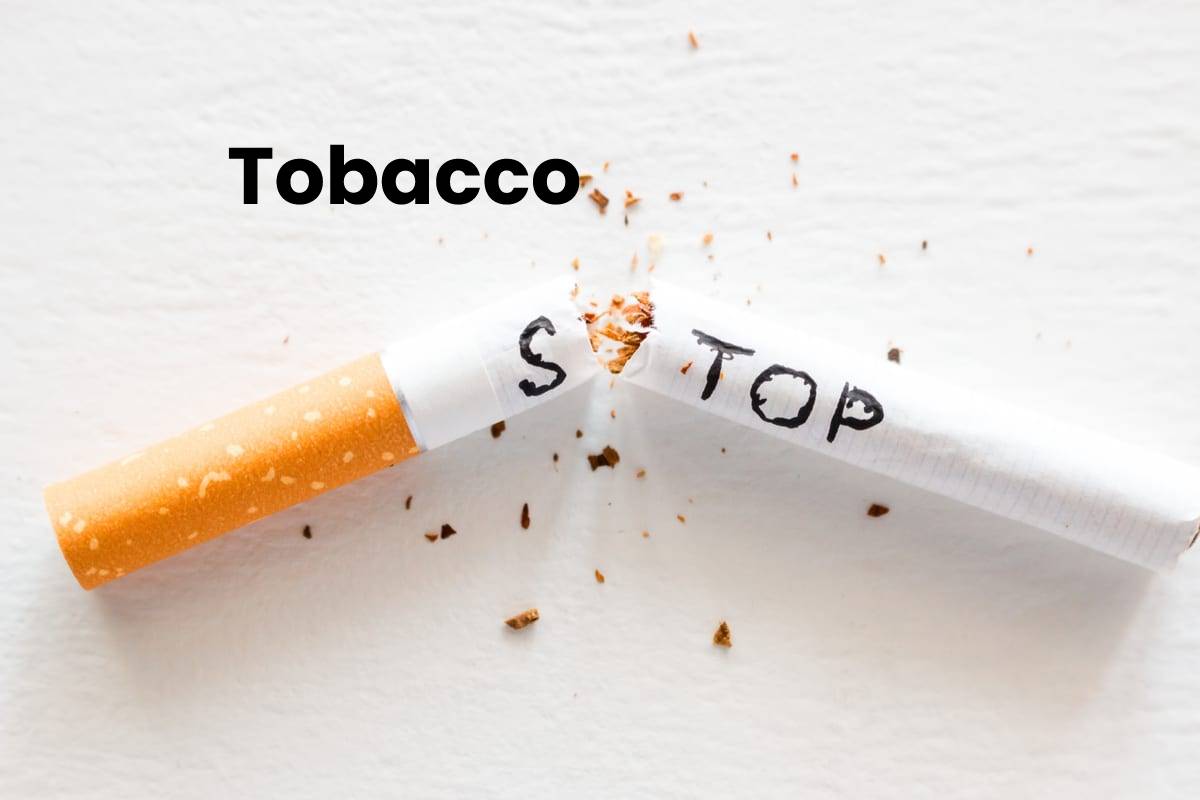
Tobacco kills over 8 million people yearly, yet 1.25 billion adults still use it despite declining global rates. From cigarettes to smokeless pouches, no form escapes the health toll of its 7,000 chemicals, including 70+ carcinogens like arsenic and benzene.
This guide covers products, risks, stats, and quitting paths for anyone assessing or escaping tobacco’s grip.
Table of Contents
What is Tobacco and Its Common Products?
Tobacco comes from the Nicotiana plant, processed into addictive products delivering nicotine.
Types of Tobacco Products
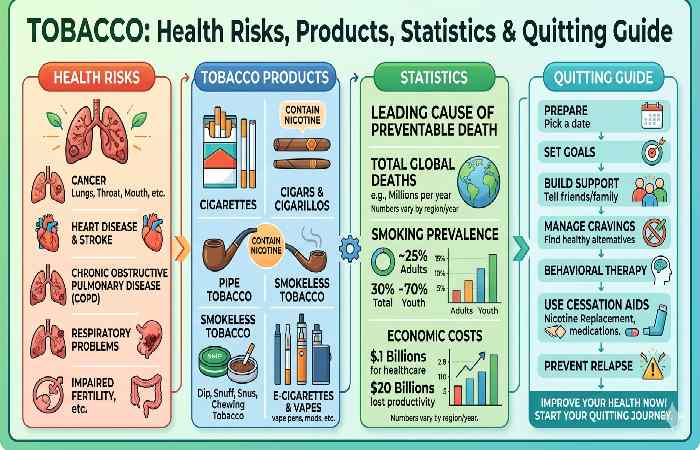
Cigarettes lead (80% users), followed by cigars, pipes, waterpipes, smokeless (snus, chew), and e-cigarettes/vapes. All carry risks on a “continuum” – smoked worst, non-combusted less so.
Key Chemicals Involved
Smoke holds tar, carbon monoxide, nicotine, TSNAs (cancer-linked), and polonium-210 (radioactive). Smokeless retains high TSNAs.
Health Effects of Tobacco Use
Within 10 seconds, toxins hit brain and heart. Long-term: 16+ cancers, COPD, heart disease.
Smoking vs Smokeless Risks
Smoking causes 90% tobacco deaths (lung cancer 63.5% in Europe). Smokeless raises oral cancer, pancreas risks – not “safe.”
Secondhand Smoke Dangers
Non-smokers exposed face 30% higher lung cancer risk, SIDS in kids, asthma worsening.
Global Tobacco Use Statistics (2026 Update)
1 in 5 adults smoke (down from 1 in 3, 2000). SE Asia (26.5%) and Europe (25.3%) highest; Europe projected 23% by 2030.
Women in Europe smoke double global average. Youth vaping rises despite declines.
Economic and Social Costs
$1.4 trillion annual global hit (healthcare, lost productivity). India: 1M+ deaths/year, high bidi/smokeless use burdens rural poor.
How to Quit Tobacco Successfully
Nicotine replacement (patches), counseling, meds (varenicline) double success rates. Cold turkey works for some.
Proven Methods and Timelines
| Time Quit | Benefits Gained |
| 20 min | Heart rate normalizes |
| 12 hrs | CO levels drop |
| 2-12 wks | Lung function improves |
| 1-9 mos | Coughing decreases |
| 1 yr | Heart disease risk halves |
| 10 yrs | Lung cancer risk halves |
Apps like QuitNow track progress.
Tobacco Control Policies Worldwide
WHO FCTC ratified by 182 countries: taxes, bans, warnings. India: 85% tax, graphic packs cut youth use 10%.
Key Measures to Reduce the Demand for Tobacco
The WHO’s MPOWER framework outlines six proven measures to reduce tobacco demand globally, credited with cutting smoking prevalence by up to 30% in implementing countries since 2007. These strategies—monitoring, protection, cessation help, warnings, advertising bans, and taxation—target initiation, addiction, and affordability, saving millions of lives annually.
MPOWER Demand Reduction Measures
| Measure | Description | Impact Evidence |
| Monitor | Track tobacco use via surveys (e.g., GATS) and policy compliance | Enables data-driven interventions; 126 countries show dose-response drops in prevalence |
| Protect | Enforce 100% smoke-free indoor public places (offices, bars, transport) | Cuts secondhand exposure 90%; SHS deaths drop 40% in high-compliance areas |
| Offer Help | Provide quitlines, NRT (patches/gum), counseling, and meds like varenicline | Doubles quit rates (25-30% success vs 10% cold turkey) |
| Warn | Mandate large graphic warnings (50%+ pack coverage) on all products | Reduces uptake 15-20%; youth initiation falls 10% |
| Enforce Bans | Prohibit tobacco advertising, promotion, sponsorship (TAPS) across media | Cuts youth smoking 7%; industry marketing spend drops 50% |
| Raise Taxes | Increase excise taxes to 75%+ retail price | Most effective: 10% hike cuts demand 4% in low-income groups |
Additional Key Strategies
- Price hikes lead: A 10% tax rise reduces consumption 4-5% overall, 11% among youth/poor.
- FCTC Articles 6-14: Non-price measures (packaging, cessation) complement taxes; full implementation halves prevalence over 10 years.
- Mass media campaigns: Graphic ads boost quit attempts 20-40% short-term.
India applies 85%+ taxes on cigarettes (NTCP), graphic packs, and TAPS bans, dropping youth use 10% since 2010. Success requires enforcement – partial measures yield 50% less impact. Start with taxes and warnings for quickest wins.
Examples of countries succeeding with high tobacco taxes
High tobacco taxes have proven highly effective in reducing consumption, generating revenue, and improving public health across diverse countries, with WHO data showing a 10% price hike typically cutting demand by 4-5% in high-income nations and up to 11% among youth/low-income groups. Success hinges on consistent increases, uniform structures, and enforcement against industry pushback.
Top Success Stories
| Country | Tax Strategy & Increases | Key Results |
| Philippines | “Sin Tax” Law (2013): 5 pesos/year hikes to 2023 + 5% annual; now ~80% tax share | Cigarette use down 34%; $3.9B extra revenue (first 3 yrs) funded universal health; industry fined $600M for evasion |
| The Gambia | Multi-year excise hikes from low base (2012+) | Imports fell 60%; revenue tripled (2011-2018); model for African nations |
| Sri Lanka | Specific excise to 77% MSP (most sold pack) | High compliance; sustained consumption drops via annual adjustments |
| Colombia | Tripled specific tax (COL$700→2,100/pack, 2016-18) + 4% yearly | 34% consumption drop; revenue boosted despite industry resistance |
| Australia | World’s highest taxes (~75% retail) + plain packs | Smoking prevalence <10%; youth uptake halved since 2010 |
- Uniform hikes: Philippines’ fixed escalators beat ad-hoc changes.
- Revenue recycling: Sin Tax funded healthcare, gaining political support.
- Youth/poor impact: Price elasticity highest (11% drop) among vulnerable groups.
- Enforcement: Colombia/Philippines penalized evasion, ensuring pass-through to prices.
Global lesson: Aim for 75%+ tax share on retail price per WHO FCTC – delivers 20-1,000x ROI over 15 years. Emerging markets like Gambia show low-base countries gain most.
FAQ SECTION
What are the health risks of tobacco?
Cancers (lung 63.5%), COPD, heart disease; 8M deaths/year globally.
Types of tobacco products?
Cigarettes, cigars, smokeless (snus), vapes – all risky.
Global tobacco use statistics 2026?
1.25B adults; down to 1 in 5 from 1 in 3 (2000).
Is smokeless tobacco safer?
No – oral cancer, pancreas risks; smoked still deadliest.
How to quit tobacco?
Patches, counseling, varenicline; benefits start in 20 min.
Secondhand smoke dangers?
30% higher lung cancer, asthma, SIDS risks.
Tobacco deaths per year?
8M+ (1.2M secondhand).
Economic cost of tobacco?
$1.4T globally; healthcare/productivity losses.